

How to Craft / Obtain

Uses for this Item (Recipes Including This)
This item is not used as an ingredient in any known crafting recipes.
About
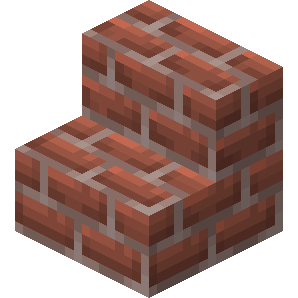
Brick stairs represent a decorative architectural variant of standard bricks designed specifically to elevate aesthetic depth and structural detailing in player-built structures across the Minecraft world. Functioning primarily as sloping blocks, they enable builders to transition smoothly between different vertical elevations while maintaining a cohesive, classic masonry theme. Their distinctive reddish-orange clay aesthetic with embedded mortar lines provides a timeless, weathered texture that complements traditional stone, wood, and brick installations. Within the broader scope of block variants, stairs are essential for roofs, ramps, and decorative framing, allowing intricate geometric designs that flat blocks cannot achieve.
Obtaining brick stairs in survival gameplay relies primarily on world exploration or player fabrication, as they generate naturally as structural components within trail ruins structures scattered across ancient worlds. When players encounter them in these archaeological sites or wish to manufacture them, they can be crafted or processed using stonecutting mechanics from standard brick blocks. Breaking any placed brick stairs requires the use of any pickaxe tier to harvest the item successfully; mining them without the proper tool category causes the block to break instantly without dropping anything. This acquisition dependency ensures that players must possess at least a basic pickaxe tool before they can salvage or relocate these decorative assets.
Core mechanics and physics dictate that brick stairs occupy a specialized half-block or quarter-block collision space depending on their orientation and placement angle, allowing entities to walk up them smoothly without jumping. When placed adjacent to other stairs or blocks, they can automatically adjust their shape to form inner and outer corners, simplifying the construction of complex architectural joints. They share the standard physical properties of stone-based building materials, meaning they are non-flammable and provide sturdy structural support for redstone components or attaching entities. Their unique collision geometry also creates functional half-slabs of space beneath overhangs, which can be utilized for hiding lighting sources or concealing wiring.
Durability and interaction rules establish that brick stairs possess moderate blast resistance and require a pickaxe to mine efficiently, matching the physical traits of the full bricks from which they derive. They do not have active durability meters as inventory equipment because they are placed block items rather than tools or weapons, but they can be destroyed and recollected repeatedly as long as the correct tool tier is applied. Interaction with fluids such as water and lava follows standard stone physics; water flowing against them conforms to their stepped shape, and they do not burn when exposed to lava sources. Their hardness value ensures they stand up well against accidental player damage while remaining manageable to re-mine and reposition during building redesigns.
Survival strategy, multiplayer utility, and automation value center heavily on their role in large-scale architectural projects, city planning, and base beautification where standard blocks look flat and uninspired. In multiplayer environments, detailed masonry work using brick stairs helps players demarcate distinct zones, build realistic medieval or industrial facades, and construct grand amphitheaters or staircases. Although they do not directly contribute to automated item farms or redstone logic gates, their aesthetic versatility allows players to design sophisticated storage hubs, aesthetic village revamps, and decorative defensive walls around bases. Their reliance on clay resources or stonecutting also encourages players to establish efficient clay-smelt production lines or automated stonecutter stations to supply large building campaigns.