

How to Craft / Obtain


Uses for this Item (Recipes Including This)
This item is not used as an ingredient in any known crafting recipes.
About
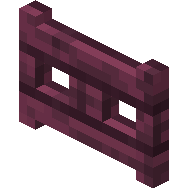
A fence gate is a versatile block in Minecraft that shares the functional characteristics of both a door and a fence. While it can be broken with any tool or item, using an axe is the fastest method to mine it. Natural generation of wooden fence gates occurs in various village types depending on the wood variant, such as oak fence gates in plains villages, spruce fence gates in taiga and snowy tundra villages, jungle fence gates in desert villages, acacia fence gates in savanna villages, and dark oak fence gates within woodland mansions. When placed in the game world, a fence gate automatically orients itself to face directly toward the player who placed it, completely independent of any surrounding fences. Furthermore, it does not require a solid block underneath for support and can successfully float in mid-air when placed without any attachments.
As a barrier and interactive switch, a fence gate can be opened or closed manually by using it, or dynamically triggered by wind charges shot by players, dispensers, or breezes. When operated, it instantly alters its orientation without displacing entities or pushing them like pistons do, and manual opening always causes the gate to swing away from the player. Although it visually appears as a single block in height, a closed fence gate functions as a one-and-a-half-block-high solid barrier that successfully prevents most mobs from jumping over it while causing any entities standing on top to rest half a block above its frame. Conversely, an open fence gate becomes entirely non-solid, closely resembling a torch or sign, allowing multiple open gates placed adjacent to one another to form a completely unobstructed passageway. Additionally, hostile mobs treat closed fence gates as solid blocks and cannot detect players through them unless detection was already established prior.
In terms of redstone integration, a fence gate acts as a functional redstone mechanism that opens immediately when activated and closes instantly upon deactivation. It can be powered by various adjacent active components located directly next to it, above, or below, including redstone torches, redstone blocks, daylight sensors, powered redstone blocks, comparators, and repeaters pointing into it, or powered redstone dust configured to point directly at the gate or sitting as a directionless dot beside it. Even when controlled by redstone, a fence gate can still be manually closed by a player, though it will remain shut until it undergoes a complete deactivation and reactivation cycle to respond to redstone once more. Moreover, fence gates can be successfully pushed by pistons, though an activated gate relocated to an invalid position will retain its state until it receives a fresh redstone update.
Beyond its mechanical utility, wooden fence gates serve practical purposes such as acting as combustible furnace fuel within the Overworld, smelting approximately 1.5 items per individual gate. Although standard survival mechanics prevent players from equipping a fence gate into the helmet slot, utilizing console commands to force-equip it causes the block to render visually as eyeglasses on the player model. The distinctive sound of a fence gate opening or closing carries across a radius of up to 16 blocks, matching the audio propagation distance of most standard mob noises in the game. These acoustic and physical properties make fence gates reliable audio cues and structural components for bases and farms alike.
Data values and block states govern how fence gates function across both Java and Bedrock editions of Minecraft, maintaining unique block IDs and state properties for orientation, openness, and wall connections. Wooden fences, nether brick fences, and walls connect seamlessly to fence gates on either side, whereas glass panes and iron bars fail to make any physical connection. When opened, the two structural sides of the gate physically separate to clear the threshold, reconnecting securely once closed to restore the complete barrier. Through these combined mechanics of redstone compatibility, mob restriction, structural connectivity, and interactive versatility, fence gates remain a fundamental building block for both aesthetic and functional designs across the entire game.