

How to Craft / Obtain

Uses for this Item (Recipes Including This)
This item is not used as an ingredient in any known crafting recipes.
About
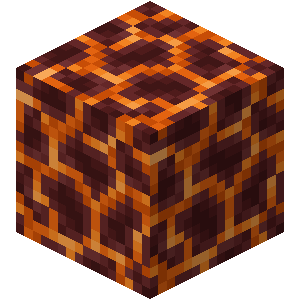
A magma block is a light-emitting block found underwater in the Overworld and commonly in the Nether. It deals burning damage while stood on, which can be prevented by sneaking, and underwater magma blocks produce bubble columns that pull entities downward while providing air. Magma blocks can be mined using any pickaxe, dropping nothing if mined without one. In the Overworld, they generate at the bottom of water aquifers in clusters of one to eight blocks, in sulfur springs in clusters of one to three blocks, and as part of ocean ruins, ruined portals not in cold biomes, and trial chamber eruption rooms. In the Nether, they generate as ore features from altitudes twenty-seven to thirty-six in all biomes replacing netherrack, as deltas in basalt deltas replacing lava, and in hoglin stables, treasure room bastion remnants, and Nether ruined portals.
Magma blocks damage most living entities standing on top of them, even underwater, dealing one health point of fire damage every tick which is reduced to once every half-second due to damage immunity. Walking into the side of a magma block does not cause damage, and damage from magma blocks does not reduce durability in netherite armor. Because magma blocks deal fire damage, it can be reduced by armor, the Resistance effect, and Protection or Fire Protection enchantments, and can be completely negated by the Fire Resistance effect. Unlike other sources of fire damage, sneaking and the Frost Walker enchantment can also grant immunity to damage from magma blocks, and mobs immune to fire take no damage from them. Additionally, shulkers and sulfur cubes with blocks inside cannot take magma block damage despite lacking natural fire immunity.
Magma blocks do not set mobs or players on fire and therefore do not cook the animals they kill or destroy items. Blocks that are the height of a trapdoor or lower, such as snow layers, carpets, repeaters, or comparators, do not prevent a magma block from damaging mobs and players above it, though a sunken boat on top prevents damage. Specific death messages exist for magma blocks, displaying that a player or named pet discovered the floor was lava when killed simply from standing on it, or that they walked into danger zone due to an attacker if knocked back to their death. Magma blocks emit a light level of three, do not melt ice or snow, emit smoke particles under rainfall like lava, prevent spiders from climbing walls made of them in Bedrock Edition, and cause fire to burn indefinitely when set on fire on top.
Mobs try to avoid walking over magma blocks but will still cross them if no other path is found, and most mobs do not spawn on them with exceptions including magma cubes, zombified piglins, ghasts, and squid. When a water source is directly above a magma block, a whirlpool bubble column is created from the highest source block, pulling down items, boats, players, and mobs while allowing players to restore breath underwater. When placed above a magma block and below a water source of one to four blocks high, potent sulfur may occasionally erupt as a geyser. A full cycle occurs every three hundred to twelve00 game ticks, while the eruption phase lasts between twenty and one hundred game ticks, with dormant and eruption durations calculated using world position values and water column height.
Geysers passing through a singular block placed above them but not directly above the water source will have some particles pass through while losing the ability to launch entities. Geysers generate naturally on the surface as part of sulfur springs when potent sulfur generates above a magma block, whereas sulfur pools in sulfur caves lack magma blocks underneath and thus feature no natural geysers. In terms of external appearances and trivia, a magma block has a light color of d3852b under the Render Dragon Features for Creators experiment, geologists restrict the term magma to deep underground molten rock while calling surface-level melt lava, and a magma block appears as Steve's Up-Smash attack in Super Smash Bros. Ultimate.