

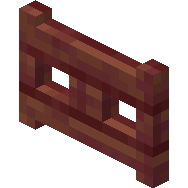
How to Craft / Obtain

Uses for this Item (Recipes Including This)
This item is not used as an ingredient in any known crafting recipes.
About
A fence gate functions as a hybrid block that combines the utility and properties of both doors and fences within the game world. When placed, a fence gate automatically orients itself to face the player who placed it, regardless of any surrounding fences, and it can be positioned successfully whether there is a solid block beneath it or not. Wooden fences, nether brick fences, and walls will connect to fence gates, whereas glass panes and iron bars do not connect, allowing a fence gate to float in mid-air when placed without adjacent supporting blocks. The block acts as a switchable barrier that opens and closes when interacted with by hand, struck by wind charges shot by a player, a dispenser, or a breeze, or controlled via redstone power.
When a fence gate opens or closes, its orientation changes immediately without applying any physical displacement force to entities in the space it passes through, meaning moving fence gates do not push entities the way pistons do. When operated by hand, a fence gate always opens away from the player. Although it visually appears to be only one block tall, a closed fence gate functions as a barrier one and a half blocks high, preventing most mobs from jumping over it while causing entities standing on top of it to rest half a block above the block's upper surface. Conversely, an open fence gate is completely non-solid, resembling a sign or a torch, and multiple open fence gates placed adjacent to each other allow players and entities to pass through the entire space seamlessly. Additionally, hostile mobs recognize closed fence gates as solid blocks and cannot detect players through them unless line-of-sight detection was already established prior to closing.
As a redstone component, a fence gate operates as a mechanism that can be activated by an adjacent active power component positioned above or below it, an adjacent powered block, a powered redstone comparator or redstone repeater facing directly toward it, or powered redstone dust configured to point into it or existing as a directionless dot next to it. Upon receiving a redstone activation signal, the fence gate opens instantly, and it closes immediately when the signal is deactivated. An activated fence gate can still be manually closed by a player, in which case it will remain shut and will not reopen until it receives a new transition from a deactivated state to an activated state. Furthermore, fence gates can be pushed and relocated by pistons, though when an activated fence gate is moved to a position where it should not technically receive power, it retains its current state until it receives a subsequent redstone update.
In terms of obtaining and processing, a fence gate can be broken using any tool or by hand, though using an axe provides the fastest breaking speed. Overworld wooden fence gates can serve as a functional fuel source when placed inside a furnace, where a single fence gate is capable of smelting 1.5 items before being consumed. While a fence gate cannot normally be equipped in the helmet inventory slot during standard Survival mode gameplay, applying the item to the head slot via administrative commands causes it to render graphically as a pair of eyeglasses on the player model. The distinct sound of opening and closing a fence gate produces audio that can be heard by nearby players and creatures up to sixteen blocks away.
The natural generation of fence gates varies extensively across different structures and wood types within the game environment. Oak fence gates generate naturally as structural components within standard plains villages, whereas spruce fence gates spawn within taiga, snowy tundra, and snowy taiga villages. Jungle fence gates appear as part of desert villages, and acacia fence gates are naturally integrated into savanna villages. Finally, dark oak fence gates generate as architectural features within woodland mansions, providing pre-built barriers and entryways across these diverse generated structures.