

How to Craft / Obtain
Uses for this Item (Recipes Including This)


About
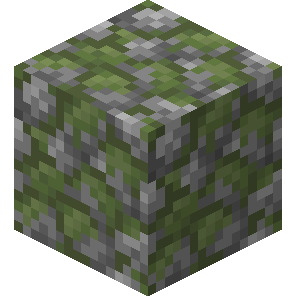
A moss block is a natural block that can be mined using any tool or by hand, although using a hoe yields the fastest breaking speed. Natural generation occurs extensively on both the floor and the ceiling within the lush caves biome. Additionally, moss blocks can be found inside trial chambers, which indicates that a trial spawner has the potential to spawn slimes under specific conditions. Players can also obtain moss blocks through mob loot drops, such as when an enderman holding a moss block dies. In Bedrock Edition, wandering traders have a 25 percent chance to drop two moss blocks when killed while showing the item as a trade offer, provided the player is holding an emerald.
Post-generation spreading mechanics allow bone meal to convert eligible blocks into moss within a large rectangular volume. When bone meal is used on a moss block in Java Edition, the game first verifies that the block directly above it is air. It then independently selects maximum horizontal distances with a 50 percent chance of being either two or three blocks. Within this 7 by 11 by 7 volume centered on the original moss block, specific probabilities determine conversion: corners have a zero percent chance, edges have a 75 percent chance, and all other interior blocks are guaranteed selection. Vertical scans search downward or upward from one block above the moss depending on whether the starting block is air or solid, converting valid blocks and offering a 60 percent chance for vegetation to generate above successfully converted locations.
The blocks eligible for moss conversion in Java Edition belong to the moss_replaceable block tag, which encompasses bases such as base_stone_overworld, cave_vines, and dirt tags. On average, a single piece of bone meal applied to a flat 7 by 7 grid of convertible blocks yields approximately 27 moss blocks, which subsequently produce about 2.5 units of bone meal when placed inside a composter. Composting a moss block directly carries a 65 percent chance of raising the compost level by one. Furthermore, moss blocks interact uniquely with various in-game items and mechanics, serving as a supportive surface for all plants except cacti, enabling small dripleaves to be placed even outside of water, and allowing Nether fungi or light-restricted mushrooms to be grown.
Sniffer eggs hatch at twice their normal speed when placed directly on top of a moss block, making moss a useful utility block for breeding and incubation setups. Regarding piston interactivity, moss blocks are completely destroyed and drop themselves as items when pushed by pistons, and they do not stick to sticky pistons, slime blocks, or honey blocks. Wandering traders may also sell two moss blocks in exchange for one emerald as part of regular trading mechanics. These combined properties establish the moss block as a versatile and renewable resource with extensive utility across farming, automation, and decorative building.