


How to Craft / Obtain
Uses for this Item (Recipes Including This)

About
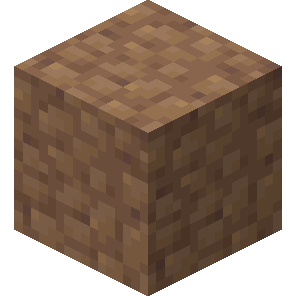
Mud is a versatile and unique block found abundantly within mangrove swamps or generated artificially through the application of a water bottle on any type of dirt block. Players can easily break mud by hand or with any tool, though employing a shovel significantly accelerates the mining process. Beyond natural generation in mangrove swamps, mud also forms inside trail ruins and select entrance rooms of trial chambers. Additionally, an enderman holding a mud block will drop the block upon death, offering another unconventional means of acquisition.
Post-generation conversion provides a reliable method for producing mud outside of natural wetlands. Players can convert blocks of dirt, coarse dirt, or rooted dirt into mud by using a water bottle, splash water bottle, or lingering water bottle on the block, which simultaneously returns an empty glass bottle. Alternatively, triggering a dispenser filled with a water bottle on these same dirt variants achieves the exact same conversion. Notably, while a player cannot use a water bottle directly on the bottom face of a dirt block to transform it, a dispenser functions successfully even when targeted at the bottom face.
As a building and mechanical block, mud possesses several distinct physical properties. It is not a full block, meaning entities standing on mud sink slightly into it in a manner reminiscent of soul sand. Unlike soul sand, however, mud exerts no slowing effect on the movement speed of players or mobs walking across its surface. Furthermore, falling blocks such as sand drop as collectible items when landing on mud, and hoppers positioned directly underneath a mud block can successfully collect items dropped on top of it. Items resting on top of mud also move alongside it when the block is pushed by a piston.
Mud serves as an essential crafting ingredient and undergoes fascinating conversions when subjected to environmental mechanics. Placing a block of mud above any solid block with a pointed dripstone hanging underneath gives the mud a 45 out of 256 chance per random tick to convert into clay, resulting in an average conversion time of 388.4 seconds, though this process fails if attempted in the Nether. In Java Edition, applying bone meal on a moss block or pale moss block with air above it converts the topmost mud blocks within a designated 7 by 11 by 7 area into moss blocks or pale moss blocks respectively.
Tree growth interactions also alter mud blocks depending on the specific sapling and game edition. Growing an azalea tree on top of mud or muddy mangrove roots converts the underlying mud into rooted dirt, which can subsequently be hoed back into standard dirt. When a large spruce tree grows, it converts the mud beneath and surrounding it into podzol. Meanwhile, in Bedrock Edition, the growth of trees other than large spruce, azalea, mangrove, and fancy oak results in the underlying mud being converted directly into regular dirt.