

Trapped chest
How to Craft / Obtain

Uses for this Item (Recipes Including This)
This item is not used as an ingredient in any known crafting recipes.
About
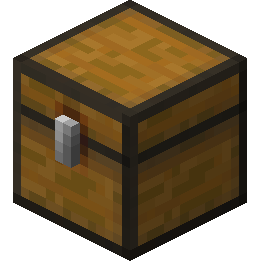
A trapped chest is a specialized storage container and redstone component that functions identically to its base counterpart while featuring a distinctive red-tinted latch and producing redstone power whenever it is open. Like normal chests, two individual trapped chests can merge into a large trapped chest if placed directly next to each other. They can be broken using any tool, though axes provide the fastest mining speed, and any items stored inside are dropped upon destruction. If one half of a large trapped chest is destroyed, the corresponding items are dropped while the remaining half continues to function independently as a small trapped chest. Natural generation of trapped chests occurs exclusively in fake end portal rooms within woodland mansions, where they always contain two ender pearls and act as a trap that activates two nearby TNT blocks when opened.
Placing a trapped chest requires positioning the face of a block adjacent to the target space, and placing two adjacent trapped chests side-by-side typically combines them into a large chest. Players can prevent this combination in Java Edition by sneaking while placing the second chest or by orienting it to face a different direction, whereas normal chests never combine with trapped chests. Trapped chests can be moved by pistons in Bedrock Edition and remain unaffected by surrounding flowing water and lava, though lava can ignite adjacent air blocks without burning the chest itself. Furthermore, trapped chests can detonate buried TNT when opened twice, which destroys the chest, its contents, and any nearby players or mobs. Piglins also become hostile toward any player who dares to open, break, or interact with trapped chests in the game world.
A single trapped chest provides 27 slots of inventory space, whereas a large trapped chest expands this capacity to 54 slots. Opening the container interface requires the use item control, and items can be moved between inventories via dragging or shift-clicking before exiting with the escape key. By default, the graphical user interface is labeled as a chest or large chest, but this can be customized by renaming the chest in an anvil prior to placement or by utilizing the data command in Java Edition. Additionally, trapped chests can be locked by setting a specific lock tag, which restricts opening to only those players who hold an item bearing an identical name to the lock tag text, such as a custom named key.
As redstone components, trapped chests are designed to detect when they are being accessed by players or copper golems, while remaining inactive when other mobs interact with them or when items are moved by hoppers and droppers. When active, a trapped chest powers adjacent redstone dust, redstone repeaters facing away, and strongly powers full solid opaque blocks beneath it to a power level proportional to the number of entities accessing it simultaneously up to a maximum level of 15. They also activate adjacent mechanism components such as pistons and redstone lamps, effectively locking any hoppers placed directly beneath them to prevent item extraction while open. In contrast, they do not power adjacent redstone comparators facing away, though comparators can still measure the block state to produce a signal proportional to how full the chest is.
Beyond storage and circuitry, trapped chests serve multiple secondary functions such as acting as a furnace fuel source capable of smelting 1.5 items per chest. On December 24, 25, and 26, their textures automatically change to festive Christmas chests resembling wrapped presents, making them visually indistinguishable from normal chests unless tested with redstone dust or viewed through the debug screen. They also have associated block entities holding additional data across both Java and Bedrock Editions, and render as full blocks in inventories on Bedrock Edition while behaving as normal non-full blocks when placed in the world.