
The server can now translate what you type in chat. Four commands are available, and together they cover every language pair the local dictionary index supports — the translation happens on the server itself, with no external service and no account.
The commands 
| Command | What it does |
|---|---|
/say-lit <text> |
Lithuanian to English, one clean translation |
/say-spa <text> |
Spanish to English, one clean translation |
/tt <source> <target> <text> |
Any supported pair, one clean translation |
/ttt <source> <target> <text> |
Any supported pair, plus the alternative senses in gray |
For example, /say-lit mano namas puts my house into chat, and /tt lit eng mano namas does the same thing with the language pair spelled out. Both /tt and /ttt take the source language first, the target language second and the text last: /tt lit eng labas vakaras.
Every translation is broadcast with the language pair and the sender's nickname in front of it, so it is always clear who said what and which way it was translated — for example [Lit-Eng] Jyothir: my house.
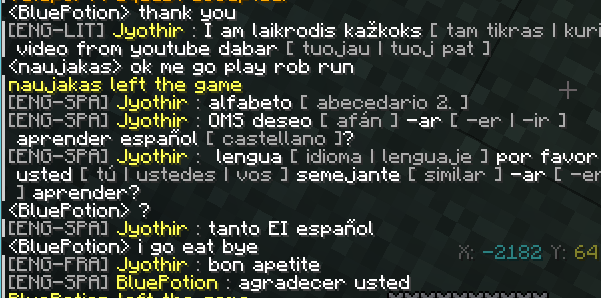
/ttt shows more than a single reading. The main translation is in white and the extra dictionary senses appear in gray brackets, which is useful when a word has several possible translations and you want to see what else it could have meant.
How it works 
The translation is dictionary-based, not AI-based. The server runs a small local service built on the FreeDict dictionaries that ship with Debian — 39 languages and 73 direct dictionary pairs in total. It looks up each word of your message in the relevant dictionary and stitches the results back together, so no network call is made, there is no rate limit, and nothing leaves the machine.
When there is no dictionary for the exact pair you asked for, the service pivots through English: it looks the word up in the source language, takes the English gloss, and looks that up in the target language. That is why /tt epo lit works even though no Esperanto to Lithuanian dictionary is installed.
Language codes 
The chat prefix uses three-letter codes, and the same codes work as the arguments of /tt and /ttt. Two-letter codes also work for most of them, so lt and lit both mean Lithuanian.
| Code | Language |
|---|---|
| Afr | Afrikaans |
| Ara | Arabic |
| Bul | Bulgarian |
| Cat | Catalan |
| Ces | Czech |
| Cym | Welsh |
| Dan | Danish |
| Deu | German |
| Ell | Greek |
| Eng | English |
| Epo | Esperanto |
| Fin | Finnish |
| Fra | French |
| Gle | Irish |
| Hin | Hindi |
| Hrv | Croatian |
| Hun | Hungarian |
| Ind | Indonesian |
| Isl | Icelandic |
| Ita | Italian |
| Jpn | Japanese |
| Kha | Khasi |
| Kur | Kurdish |
| Lat | Latin |
| Lit | Lithuanian |
| Nld | Dutch |
| Nor | Norwegian |
| Pol | Polish |
| Por | Portuguese |
| Rom | Romanian |
| Rus | Russian |
| Slk | Slovak |
| Slv | Slovenian |
| Spa | Spanish |
| Srp | Serbian |
| Swe | Swedish |
| Swh | Swahili |
| Tur | Turkish |
| Zho | Chinese |
The prefix in chat shows exactly these codes, so a Lithuanian message translated to English comes out as [Lit-Eng].
What can be translated 
Into English (32 languages): Afrikaans, Arabic, Catalan, Czech, Welsh, Danish, German, Greek, Esperanto, Finnish, French, Irish, Croatian, Hungarian, Icelandic, Italian, Japanese, Khasi, Kurdish, Latin, Lithuanian, Dutch, Polish, Portuguese, Russian, Slovak, Slovenian, Spanish, Serbian, Swedish, Swahili, Turkish.
Out of English (32 languages): Afrikaans, Arabic, Bulgarian, Catalan, Czech, Welsh, Danish, German, Greek, Finnish, French, Irish, Hindi, Croatian, Hungarian, Indonesian, Italian, Japanese, Latin, Lithuanian, Dutch, Norwegian, Polish, Portuguese, Romanian, Russian, Spanish, Serbian, Swedish, Swahili, Turkish, Chinese.
Both directions (26 languages): Afrikaans, Arabic, Catalan, Czech, Welsh, Danish, German, Greek, Finnish, French, Irish, Croatian, Hungarian, Italian, Japanese, Latin, Lithuanian, Dutch, Polish, Portuguese, Russian, Spanish, Serbian, Swedish, Swahili, Turkish.
Into English only — these have no dictionary in the other direction: Esperanto, Icelandic, Khasi, Kurdish, Slovak, Slovenian.
Out of English only — these can be translated into, but not out of, English: Bulgarian, Hindi, Indonesian, Norwegian, Romanian, Chinese.
Lithuanian specifically has English on both sides plus direct dictionaries for German, Greek, Finnish, French, Italian, Dutch, Polish, Swedish and Chinese. Every other combination listed above works through the English pivot, so /tt accepts any pairing of those languages.
What it is not 
This is a dictionary lookup, not a translation engine. It translates word by word: it does not conjugate verbs, reorder clauses, handle idioms, or keep the gender and case of the original sentence. A word that is not in the dictionary is passed through unchanged, which is why an unknown name or a made-up word shows up in the output exactly as it was typed.
The quality is therefore the quality of the dictionaries themselves. Expect something like lift work for a Lithuanian phrase about lifting and working, not a polished sentence. But if somebody is trying to tell you where to build, that their base was raided, or that they are leaving in ten minutes, the message does get across — and a rough translation that arrives is better than no message at all. That is the point: players who do not share a language can now talk to each other more or less.
Inspiration 
This was requested by a player from Costa Rica with the nickname jonathan182828, who wanted a way to talk to people on the server without speaking their language. It is not clear whether he will come back to find that it is already done. When the request came in I thought it would take about 30 minutes to implement; in the end it took closer to eight hours, most of it spent getting the dictionary service, the command side and the output formatting to agree with each other.